Java Programming Question
def check_palin (str): for i in range (0, int (len (str)/2)): if str [i] != str [len (str) -i-1]: return False return True str_1 = input (“Enter a string.”) ans = check_palin (str_1) if (ans): print (“Yes, it is a palindrome.”) else: print (“No, it is not a palindrome.”)
A string is said to be palindrome if the reverse of the string is the same as the string. In this article, we will learn how to check whether the given string is palindrome or not using C program.
Example
Input*: str = “madam”
Output: “madam” is palindrome.
Explanation: The reverse of “madam” is “madam”. So, it is palindrome*Input*: str = “hello”
Output: “hello” is not palindrome.
Explanation: The reverse of “hello” is “olleh”. So, it is not palindrome*

In C, there are mainly two different ways to check whether the string is palindrome or not:
Table of Content
Checking for a palindrome in C is a great exercise for string manipulation. To further explore string operations and data structures, the C Programming Course Online with Data Structures provides step-by-step guides on string handling and other common algorithms.
By Reversing String
The idea is to reverse the given string and store it in a temporary array. Then compare both of them using strcmp() function. If they are equal, then the string is palindrome, otherwise, it is not.
Code Implementation
C1
// Program to check for a palindrome string by reversing
2
// the string
3
#include <stdio.h>
4
#include <string.h>
5
#include <stdbool.h>
6
#include <stdlib.h>
7
8
char *strrev(char *str) {
9
int len = strlen(str);
10
11
// Temporary char array to store the
12
// reversed string
13
char *rev = (char *)malloc
14
(sizeof(char) * (len + 1));
15
16
// Reversing the string
17
for (int i = 0; i < len; i++) {
18
rev[i] = str[len - i - 1];
19
}
20
rev[len] = '\0';
21
return rev;
22
}
23
24
void isPalindrome(char *str) {
25
26
// Reversing the string
27
char *rev = strrev(str);
28
29
// Check if the original and reversed
30
// strings are equal
31
if (strcmp(str, rev) == 0)
32
printf("\"%s\" is palindrome.\n",
33
str);
34
else
35
printf("\"%s\" is not palindrome.\n",
36
str);
37
}
38
39
int main() {
40
41
// Cheking for palindrome strings
42
isPalindrome("madam");
43
isPalindrome("hello");
44
45
return 0;
46
}
Output
"madam" is palindrome.
"hello" is not palindrome.
Time Complexity: O(n), where n is the length of the string.
Auxiliary Space: O(n), for storing the reversed string.
By Using Two Pointers
In this method, two index pointers are taken: one pointing to the first character and other pointing to the last character in the string. The idea is to traverse the string in forward and backward directions simultaneously while comparing characters at the same distance from start and end.
If a pair of distinct characters is found, then the string is not palindrome.
If the two pointers meet at the middle of the string without any mismatched characters, then it is palindrome.
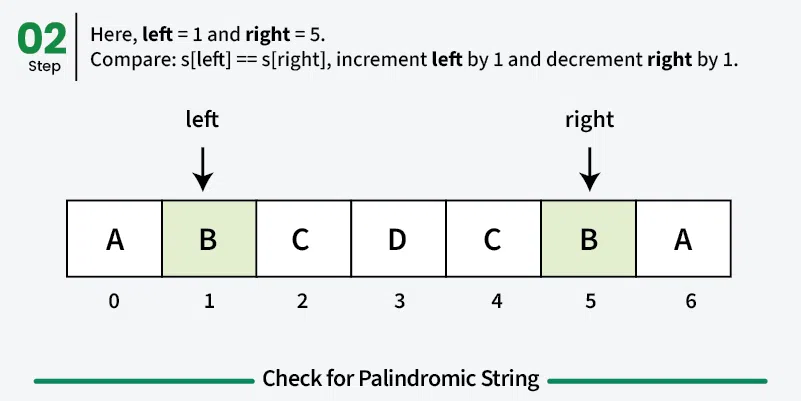
2 / 4
C1
// Program to check for a palindrome string
2
// using two pointers
3
#include <stdio.h>
4
#include <string.h>
5
#include <stdbool.h>
6
7
void isPalindrome(char *str) {
8
9
// Index pointer to the start
10
int left = 0;
11
12
// Index pointer to the end
13
int right = strlen(str) - 1;
14
15
// Run the loop till both pointer
16
// meet
17
while (left < right) {
18
19
// If characters don't match,
20
// string is not palindrome
21
if (str[left] != str[right]) {
22
printf("\"%s\" is not palindrome.\n",
23
str);
24
return;
25
}
26
27
// Move both pointers towards
28
// each other
29
left++;
30
right--;
31
}
32
33
// If all characters match,
34
// string is palindrome
35
printf("\"%s\" is palindrome.\n",
36
str);
37
}
38
39
int main() {
40
41
// Checking if given strings are palindrome
42
isPalindrome("madam");
43
isPalindrome("hello");
44
return 0;
45
}
Output
"madam" is palindrome.
"hello" is not palindrome.
Time complexity: O(n), where n is the number of characters in the string.
Auxiliary Space: O(1)
By Using Recursion
Two-pointer approach can also be implement using recursion. The current first and last index pointers (representing the current first and last characters) can be passed to the function as arguments.
If the characters at these pointers match, the function increments first pointer, decrements second pointer and then call itself again with updated pointers.
Otherwise, it returns false as the string is not palindrome.
If all the characters match till the first pointer is less than the last pointer, the string is palindrome so return true.
Code Implementation
C1
// Program to check for a palindrome string
2
// using a recursive approach
3
#include <stdio.h>
4
#include <string.h>
5
#include <stdbool.h>
6
7
// Recursive helper function to check if the string
8
// is palindrome
9
bool palinHelper(char *str, int left, int right) {
10
11
// If the start and end pointers cross
12
// each other, it means all characters
13
// have matched
14
if (left >= right)
15
return true;
16
17
// If characters don't match,
18
// string is not palindrome
19
if (str[left] != str[right])
20
return false;
21
22
// Recursively check for the rest of
23
// the string
24
return palinHelper(str, left + 1, right - 1);
25
}
26
27
void isPalindrome(char* str) {
28
29
// Calling the recursive function to check
30
// palindrome string
31
if (palinHelper(str, 0, strlen(str) - 1))
32
printf("\"%s\" is palindrome.\n", str);
33
else
34
printf("\"%s\" is not palindrome.\n", str);
35
}
36
37
int main() {
38
39
// Checking if the given strings are palindrome
40
isPalindrome("madam");
41
isPalindrome("hello");
42
return 0;
43
}
Output
"madam" is palindrome.
"hello" is not palindrome.
Time complexity: O(n), where n is the number of characters in the string.
Auxiliary Space: O(n), due to recursive stack space.